See how Innova consumes
75%LESS POWER
Case Studies & Success Stories

Over an identical, independently monitored winter period, INNOVA’s PTHP delivered better comfort - a steadier, more even room temperature - at less than one quarter of the power consumed by an advanced competing cold-climate PTHP.
When contractors and developers compare heat pump performance, the conversation usually begins with a spec sheet. Then, a visit to the AHRI PTHP (Packaged Terminal Heat Pumps) certification database. Ratings matter. They give engineers and building owners a standardized way to compare equipment. AHRI certification is designed to show that the unit delivers the efficiency it declares, under standardized test conditions. However: certification doesn’t capture how units behave across real, unpredictable winter conditions.
Before committing to the installation of INNOVA units across their portfolio, a New York property developer wanted independent verification of INNOVA’s efficiency claims.
They engaged Steven Winter Associate (SWA), a prestigious building-science consultancy firm, to design and execute a comparative study. SWA set to reveal if (and how) paper ratings translate to real-world performance. The designed a side-by-side winter field test in an occupied NYC apartment building. Then, installed two AHRI-certified inverter units - an INNOVA PTHP and a rival manufacturer’s cold-climate PTHP - in identical, vacant, north-facing apartments.
During the coldest weeks of February and March, SWA set both heat pumps to 75°F on high fan speed. To ensure accurate comparative data:
Over an identical, independently monitored span of time, INNOVA’s PTHP used just 156 kWh of total energy compared to 677 kWh for a competing, AHRI-certified, inverter PTHP. This reflects a 75% reduction in power consumed, or better than four times less energy, to hold the same room at the same 75°F setpoint.
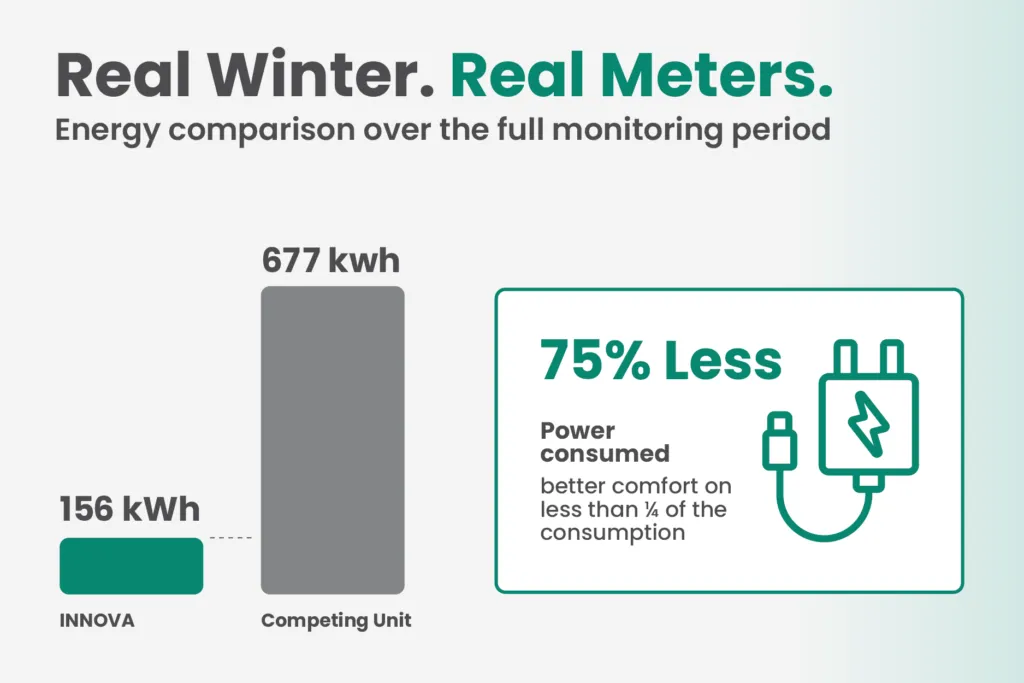
On the single coldest day of the study, the competing unit burned 31.6 kWh against 8.2 kWh for the INNOVA unit. That represents nearly a 4x gap on the harshest day of the winter. Peak electrical draw followed the same pattern: about 1.7 kW for the competing unit versus roughly 0.9 kW for the INNOVA PTHP, close to half the demand per unit.
These are substantial differences. They are the kind of differences that impact operating costs, peak electrical demand and ultimately resident comfort.
Heating loads are constantly changing, and a heat pump rarely operates at its maximum output 24/7. An efficient system must do more than just deliver heat on a cold morning, it must also know how to reduce the output when a room needs only a little heat.
The INNOVA PTHP’s consistent, linear modulation held the room at a steady, even temperature throughout the monitored period. That’s comfort that stays put, not comfort that oscillates around the setpoint. That difference affects electricity consumption as well as temperature stability.
Two units can carry comparable ratings, yet still deliver varying energy consumption while they’re doing real work in a real building through a brutally cold winter. This isn’t a criticism of the competitor’s product, nor does it claim that the competing unit is mislabeled, or fails to meet the AHRI specifications. This review’s purpose is to present, accurately and objectively, how the INNOVA PTHP performed relative to a competing PTHP under identical, independently monitored conditions. These reflect real-world scenarios, where inverter logic, control strategy and modulation behavior can create a massive difference between two certified systems. Two units can carry similar certified ratings - yet perform completely differently in the field.
Looking to reduce energy consumption in your next building retrofit?Read the full Steven Winter Associates field study or contact the INNOVA engineering team to learn more.
See how Innova consumes
75%LESS POWER